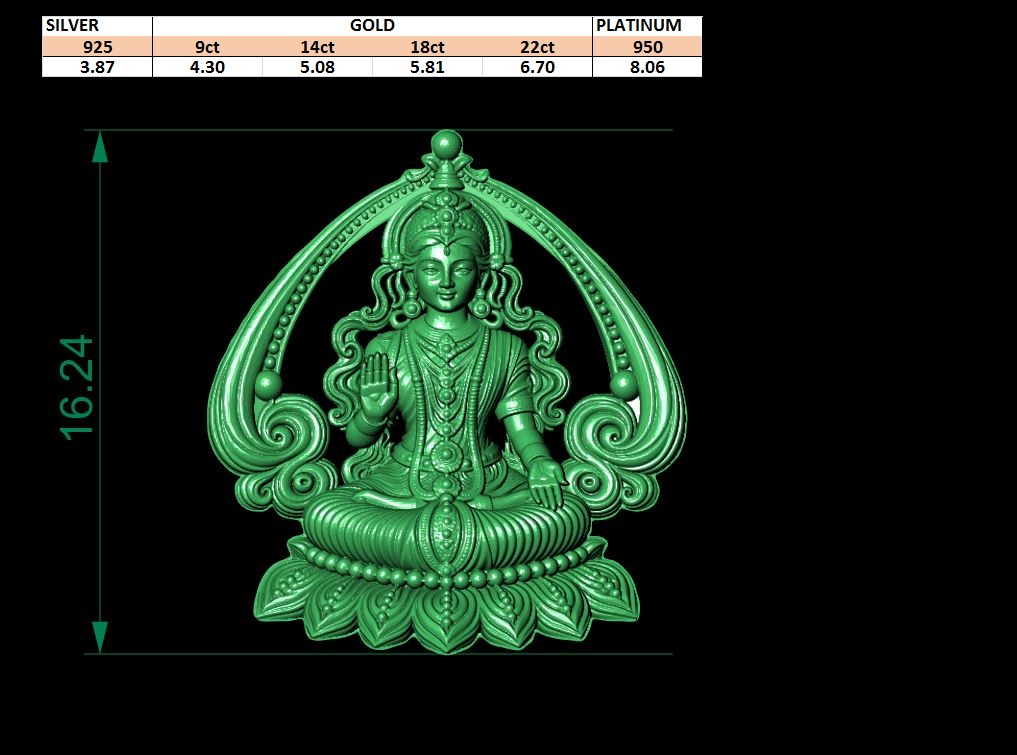
Laxmi Pendant 3D Model: High-Detail Jewelry Design for 3D Printing
A Laxmi Pendant 3D Model is a beautiful choice for creating detailed and artistic jewelry designs. Goddess Laxmi-inspired pendant designs are especially popular for custom jewelry because they combine traditional artistic elements with modern manufacturing technology. With a high-quality digital 3D model, jewelry designers can create, customize, render, and prepare unique pendant designs for professional production.
Modern jewelry manufacturing uses 3D modeling to improve accuracy and simplify the design process. Instead of creating every pendant completely by hand, designers can start with a professionally detailed jewelry 3D model and customize it according to the required size, shape, thickness, and manufacturing method.
High-Detail Laxmi Pendant 3D Model
This Laxmi Pendant 3D Model is designed with detailed facial features, ornaments, clothing elements, and decorative patterns. The intricate design helps create a visually attractive pendant while providing a strong digital foundation for jewelry production.
For jewelry manufacturing, details are extremely important. Small facial and ornamental features need to remain clear after scaling and manufacturing. A properly prepared 3D model allows designers to inspect these details digitally before creating the physical jewelry piece.
The model can also be customized according to the desired pendant size. Designers may adjust proportions, modify ornamental elements, or combine the central Laxmi design with their own pendant borders and mounting structures.
Laxmi Pendant for 3D Printing
One of the major advantages of a 3D printable jewelry model is the ability to create accurate prototypes before final production. Jewelry designers can use a digital model to test the appearance and proportions of a pendant before manufacturing it in the final material.
Depending on the production workflow, the model may be prepared for resin 3D printing, casting, CNC-related workflows, or other compatible jewelry manufacturing processes.
Before printing, the model should be checked carefully for mesh integrity, wall thickness, minimum feature size, unsupported areas, and overall dimensions. These technical checks are important because very small details may require adjustments depending on the selected printing and casting process.
Custom Jewelry Design
A Laxmi Pendant 3D Model can be used as a foundation for creating personalized jewelry. Designers can change the pendant size, add a decorative border, modify the bail, or integrate additional ornamental elements.
For jewelry businesses, digital customization provides an efficient way to create multiple variations from one base design. Different customers may require different pendant sizes or design details, and a digital 3D workflow makes these modifications easier.
The model can also be rendered digitally to create product previews. This allows designers and customers to review the appearance of the pendant before physical production begins.
Suitable for Jewelry Designers and Manufacturers
A detailed jewelry 3D model can be useful for professional jewelry designers, 3D artists, manufacturers, and jewelry printing specialists. It can help reduce repetitive modeling work and provide a reliable starting point for a new custom pendant.
The Laxmi design can be especially suitable for artistic and traditional-inspired jewelry collections. Its detailed structure can be adapted for different jewelry styles while maintaining the main character of the original design.
When preparing the final production file, designers should always consider the requirements of their manufacturing method. The appropriate thickness, clearance, support structure, and minimum detail size can vary depending on the printer, material, and casting process.
Why Use a Laxmi Pendant 3D Model?
Using a ready-made Laxmi Pendant 3D Model can save valuable design time while giving jewelry professionals more freedom to customize the final product. Instead of starting the entire design from zero, designers can focus on refinement, proportions, finishing details, and production preparation.
A high-detail digital model can also make it easier to create multiple versions of the same concept. Designers can produce different pendant sizes, modify borders, add stones or other decorative elements, and prepare the design for different jewelry collections.
Conclusion
The Laxmi Pendant 3D Model combines traditional-inspired jewelry design with modern digital manufacturing technology. Its detailed structure makes it a useful starting point for custom pendants, jewelry 3D printing, prototyping, rendering, and professional jewelry production.
For jewelry designers and manufacturers looking to create unique Laxmi-inspired pendants, a high-quality jewelry 3D model provides flexibility, accuracy, and a faster digital workflow. With proper scaling and technical preparation, the model can be adapted to different jewelry manufacturing requirements and customized into a distinctive final pendant.