
The jewelry industry has always depended on creativity, craftsmanship, and precision. In the past, creating a beautiful ring, pendant, bracelet, or other jewelry piece often started with a hand-drawn sketch. A CAD designer would then transform that idea into a digital 3D model..
Today, however, Artificial Intelligence (AI) and 3D technology are changing the way the jewelry industry works. AI can help designers generate new ideas, analyze reference images, create design concepts, improve productivity, and speed up different parts of the 3D jewelry workflow.
In this article, we will explore how AI is working in the 3D jewelry market and how it can benefit jewelry designers, CAD artists, STL sellers, and buyers.
The Connection Between AI and 3D Jewelry
AI can be used at different stages of the 3D jewelry design process. A designer can provide a text description, explain an idea, or upload a reference image. AI can then help generate visual concepts and design inspiration based on that information.
For example, a designer might enter a prompt such as:
“Create a luxury gold ring with a detailed snake design and diamond settings.”
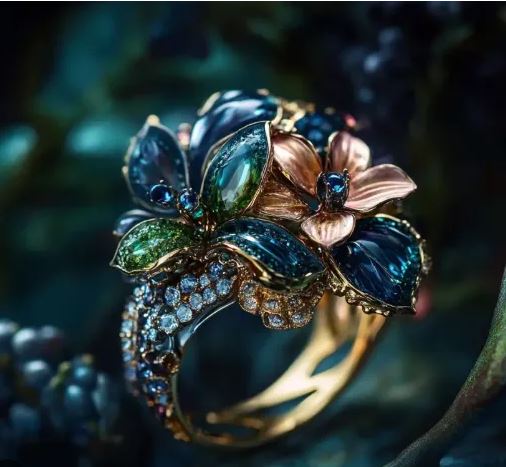
AI can generate a visual concept that helps the designer explore the overall look and direction of the jewelry piece. A skilled CAD designer can then use that concept as a reference and create a detailed 3D model.
In this way, AI can help speed up creativity and concept development, while the CAD designer uses technical skills to turn the idea into an accurate and usable jewelry model.
Generating New Jewelry Design Ideas with AI
Creating unique jewelry designs can be challenging. Customers often want something different, modern, and personalized. AI can help designers quickly explore multiple creative directions.
AI can assist with ideas for:
-
Gold rings
-
Diamond rings
-
Name pendants
-
Religious jewelry
-
Animal-inspired jewelry
-
Snake design jewelry
-
Floral jewelry
-
Luxury bracelets
-
Earrings
-
Custom engagement rings
Instead of spending hours brainstorming a single concept, a designer can use AI to explore multiple variations of an idea.
For example:
“Create a modern luxury lion ring with a detailed mane and gemstone setting.”
The AI-generated concept can provide inspiration and help the designer decide which direction to take before starting the CAD modeling process.
Using Reference Images in the 3D Jewelry Workflow
Another important use of AI is helping designers work with reference images.
For example, a customer may have a picture of a jewelry design and want something inspired by that concept. A designer can study the reference to understand important elements such as:
-
Overall shape
-
Ring or pendant structure
-
Decorative details
-
Stone placement
-
Symmetry
-
Surface patterns
AI tools may also assist with concept interpretation and image-based workflows. However, it is important to understand that an AI-generated image is not the same as a production-ready 3D jewelry model.
A jewelry model intended for manufacturing requires careful attention to technical details such as:
-
Accurate dimensions
-
Stone settings
-
Wall thickness
-
Metal weight
-
Ring size
-
3D printing requirements
-
Casting suitability
For this reason, a skilled CAD artist and proper quality control remain extremely important.
How Does a 3D Jewelry STL Marketplace Work?
Digital products are becoming increasingly popular, and a 3D Jewelry STL Marketplace can connect CAD artists, jewelry designers, and buyers from around the world.
Designers or CAD artists can upload their 3D models to the marketplace. Buyers can search for designs and purchase or download the files according to their needs.
A typical workflow may look like this:
Designer Creates a Model → STL File Is Prepared → Model Is Uploaded to the Marketplace → Buyer Searches for a Design → Purchase or Download → 3D Printing or Casting Workflow
One major advantage of digital products is that a model can potentially be sold to multiple customers without manufacturing and shipping a new physical product every time.
This creates new opportunities for CAD designers and digital product businesses.
How AI Can Improve a 3D Jewelry Marketplace
AI is not only useful for generating design ideas. It can also support several parts of a 3D jewelry marketplace.
1. Smart Search
AI-powered search can help buyers find relevant models more efficiently.
For example, a buyer might search for:
“Luxury snake ring with stone setting.”
A smarter search system may help understand related keywords, categories, styles, and design concepts, making it easier for users to discover relevant products.
2. Automatic Product Descriptions
When a designer uploads a new 3D model, AI can help create product information such as:
-
Model name
-
Design style
-
Product description
-
Category
-
SEO description
-
Relevant tags
This can save time, especially for marketplaces with a large number of models.
3. SEO and Content Creation
SEO and content marketing can play an important role in bringing visitors to a 3D jewelry marketplace. AI can help create:
-
Blog topic ideas
-
Article outlines
-
SEO-friendly content
-
Product descriptions
-
Social media captions
-
YouTube video ideas
Examples of useful blog topics include:
-
Best 3D Jewelry Design Trends
-
How to Choose the Right STL File
-
Jewelry CAD Design for Beginners
-
How 3D Printing Is Changing Jewelry Manufacturing
This type of content can help attract potential visitors from search engines and social media platforms.
AI and CAD Designers: A Powerful Combination
AI does not necessarily mean that skilled jewelry designers or CAD artists will become unnecessary. In fact, one of the most effective approaches is combining AI with human expertise.
AI can generate ideas and visual concepts quickly. However, an experienced CAD designer understands important technical questions such as:
-
Can this design actually be manufactured?
-
Is the stone setting correct?
-
What could the metal weight be?
-
How should the ring size be adjusted?
-
Is the model suitable for 3D printing?
-
Is it ready for the casting process?
Because of this, AI is best viewed as a creative and productivity tool, rather than a complete replacement for professional jewelry designers.
The Future of the 3D Jewelry Industry
In the future, AI, CAD software, 3D scanning, and 3D printing may become even more closely connected.
A possible future workflow could look like this:
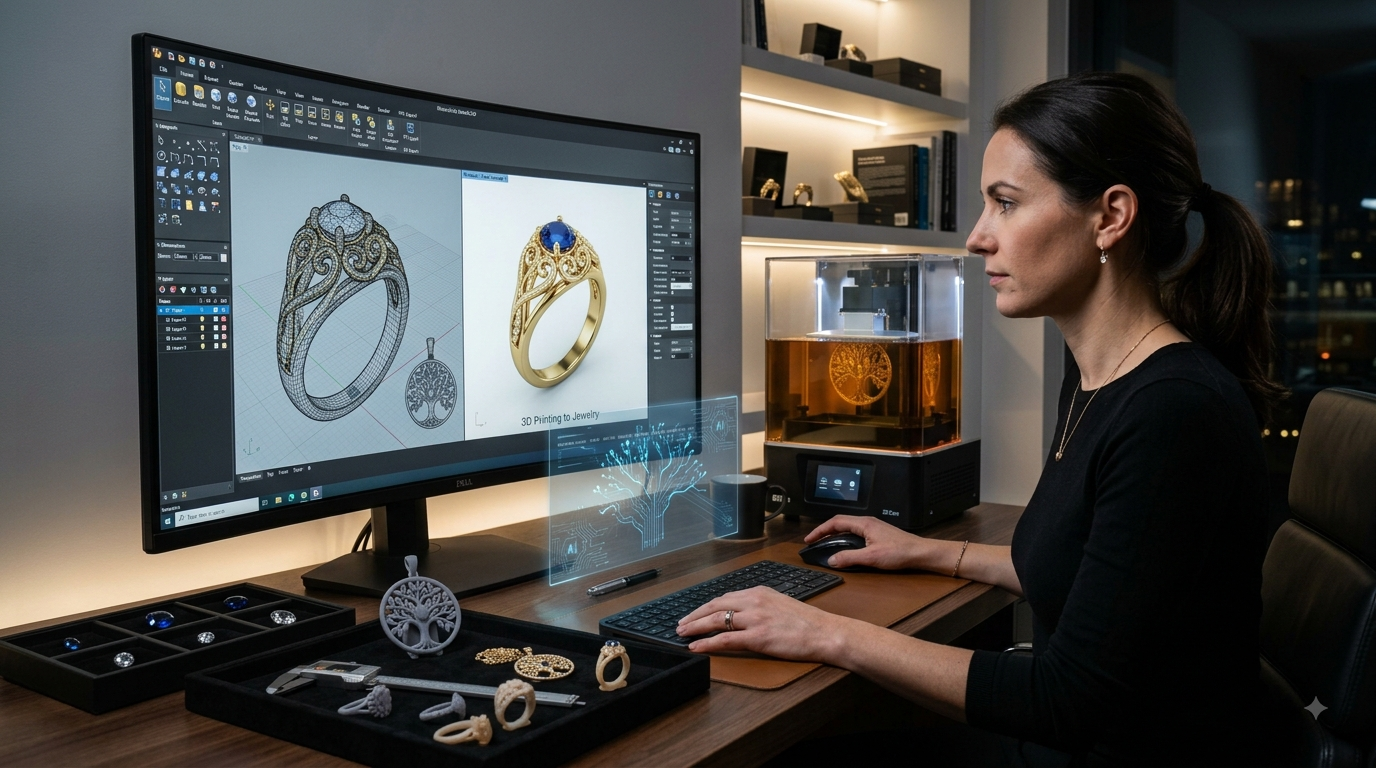
Customer Idea → AI Concept → Designer Review → CAD Modeling → Quality Check → STL or 3DM File → 3D Printing → Casting → Final Jewelry
This type of workflow can potentially make custom jewelry development faster and more flexible.
Online STL marketplaces can also connect designers and buyers internationally. A CAD artist in one country may be able to sell a digital jewelry model to a designer, manufacturer, or business in another part of the world.
Conclusion
AI is gradually transforming the 3D jewelry market. It can help generate new design ideas, support concept development, assist with content creation, and improve productivity.
At the same time, skilled CAD designers remain essential for creating accurate, high-quality, and production-ready jewelry models.
The most powerful approach is likely to be a combination of:
AI + Human Creativity + CAD + 3D Printing
AI can make the creative process faster, while human expertise provides technical knowledge, quality control, and manufacturing accuracy.
As AI and 3D technologies continue to develop, designers and businesses that learn how to use these tools effectively may discover new opportunities in the growing digital jewelry industry.