
The Role of 3D Printing in Modern Jewelry Creation
The jewelry industry has always been a combination of creativity, craftsmanship, and innovation. For centuries, jewelers relied primarily on hand-drawn sketches and traditional manufacturing techniques to create rings, pendants, bracelets, earrings, and other pieces.
Today, technology is transforming the entire jewelry creation process.
One of the biggest innovations is 3D printing. Combined with CAD (Computer-Aided Design), 3D modeling, and advanced manufacturing technologies, 3D printing is helping jewelry designers create detailed, customized, and complex designs faster than ever before.
From a simple digital idea to a physical prototype ready for casting, 3D printing has become an important part of modern jewelry production.
What Is 3D Printing in Jewelry?
3D printing, also known as additive manufacturing, is a process of creating a three-dimensional object from a digital 3D model.
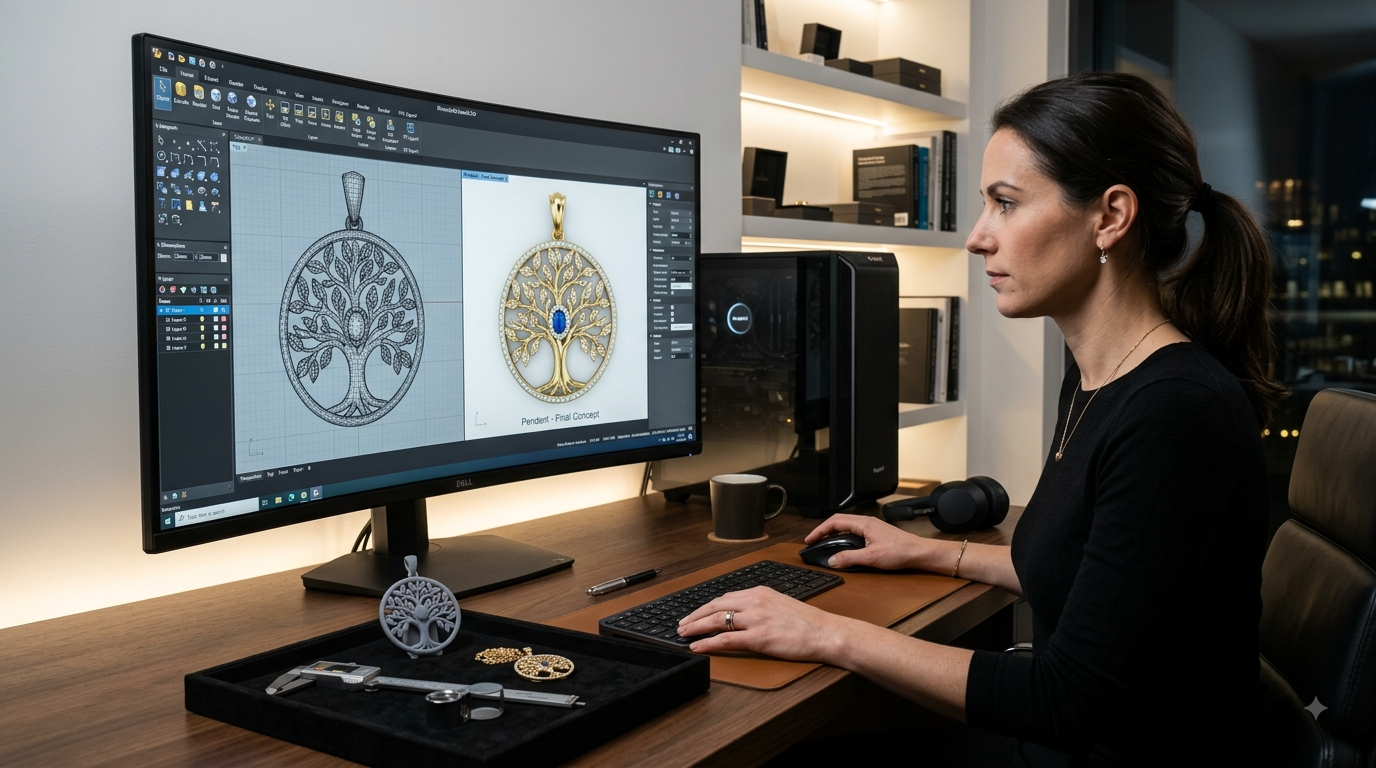
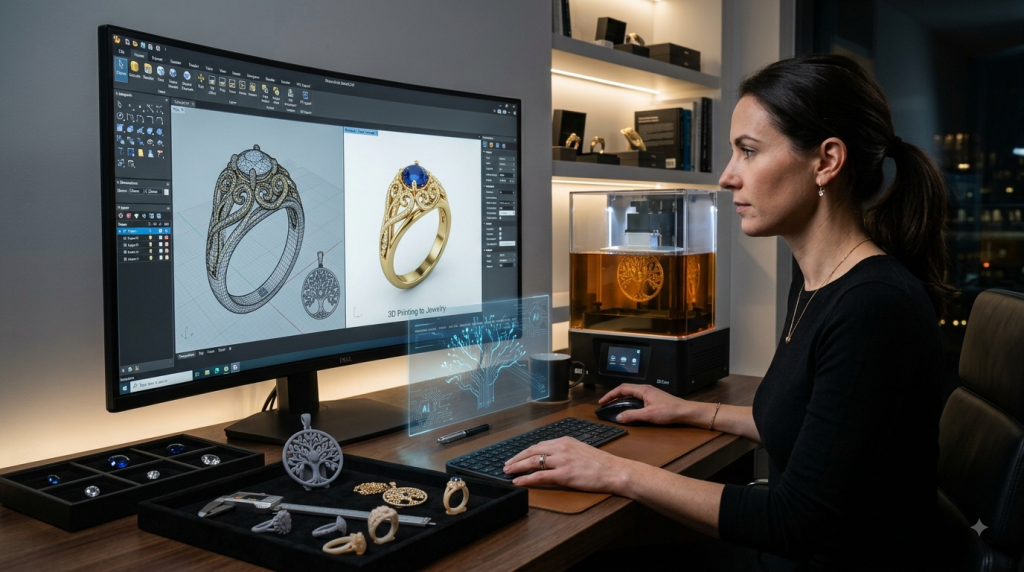
In jewelry production, a designer first creates a digital model using jewelry CAD software. The design can then be produced using a specialized 3D printer.
Depending on the production method, the printed model may be used as:
- A design prototype
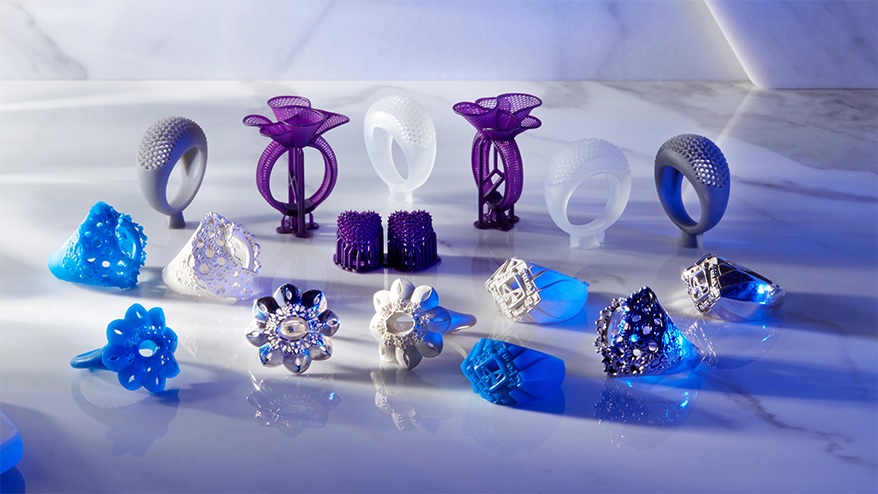
- A wax or castable resin pattern
- A master model for mold making
- A presentation or sample piece
- A pattern for investment casting
The final jewelry piece can then be produced in materials such as gold, silver, platinum, or other metals.
From Idea to Digital Jewelry Design
The modern jewelry workflow often begins with an idea.
A customer may provide:
- A hand sketch
- A reference image
- An existing jewelry photograph
- A concept or description
- A personalized design requirement
A jewelry designer or 3D modeler can transform that idea into a detailed digital model.
Using CAD software, designers can control important elements such as:
- Ring size
- Stone placement
- Metal thickness
- Prong design
- Engraving
- Weight estimation
- Symmetry
- Surface details
Once the 3D model is complete, it can be prepared for printing and manufacturing.
This digital workflow gives designers much greater control before any physical metal is used.
Faster Jewelry Prototyping
Traditional jewelry prototyping can take a significant amount of time, especially when a design requires multiple modifications.
With 3D printing, a digital design can be turned into a physical prototype much faster.
For example, a designer can create a ring model, print it, inspect the proportions, and identify possible problems before moving to the final production stage.
If changes are required, the designer can modify the digital file and print another version.
This makes the design process more flexible and efficient.
Key Advantages of Faster Prototyping
- Reduced development time
- Easier design testing
- Faster revisions
- Better visualization
- Improved communication with clients
- More confidence before final production
For custom jewelry businesses, this can be especially valuable.
Creating Complex Jewelry Designs
One of the biggest advantages of 3D printing is the ability to create complex geometries.
Some jewelry designs can be extremely difficult to produce manually. This includes:
- Detailed filigree patterns
- Organic shapes
- Complex lattice structures
- Custom name jewelry
- Intricate animal designs
- Religious pendants
- Detailed sculptures
- Geometric patterns
With 3D modeling and 3D printing, designers can create highly detailed structures that would otherwise require extensive manual work.
However, the digital model still needs to be properly designed for manufacturing. Details such as minimum wall thickness, stone settings, casting requirements, and polishing accessibility must be considered.
This is why skilled jewelry CAD modeling remains an important part of the process.
Custom Jewelry Has Become Easier
Modern customers increasingly want jewelry that feels personal and unique.
3D printing supports customization by allowing designers to quickly modify a digital model.
For example, a customer may request:
- Their name or initials
- A specific gemstone arrangement
- A custom symbol
- A personalized message
- A unique pendant
- A modified ring design
- A custom animal or portrait design
Instead of creating an entirely new piece from scratch every time, designers can sometimes modify an existing digital model to meet the customer’s requirements.
This makes personalized jewelry production more practical.
Reducing Material Waste
Traditional manufacturing methods may involve removing material from a larger block or creating multiple physical prototypes.
Digital design and additive manufacturing can help improve the development process by allowing designers to test and refine a model before committing to expensive materials.
A 3D-printed prototype can reveal potential design problems before the final piece is produced in precious metal.
This may help reduce unnecessary mistakes, rework, and material loss.
For expensive metals such as gold and platinum, accurate planning before production is especially important.
Better Communication Between Designer and Customer
One of the challenges in custom jewelry is helping a customer understand what the final piece will look like.
A simple sketch may not always communicate the full design.
A 3D model provides a much clearer visualization.
Customers can potentially view:
- Different angles
- Stone positions
- Overall proportions
- Surface details
- Personalized elements
A physical 3D-printed sample can make the experience even more realistic.
This allows customers to provide feedback before the final piece goes into production.
As a result, designers and customers can communicate more effectively.
The Typical 3D Printing Jewelry Workflow
A modern jewelry production workflow may look like this:
Step 1: Concept Development
The process begins with an idea, sketch, reference image, or customer requirement.
Step 2: 3D CAD Modeling
A jewelry designer creates the digital 3D model using CAD software.
Step 3: Model Checking
The model is reviewed to ensure that important details such as thickness, stone settings, proportions, and structural strength are appropriate.
Step 4: 3D Printing
The digital model is printed using a suitable 3D printing technology and material.
Step 5: Post-Processing
The printed model may require cleaning, curing, or other preparation depending on the printing method.
Step 6: Casting
For many jewelry workflows, the printed pattern is used in a casting process to create the final metal piece.
Step 7: Finishing
The final jewelry piece may then go through processes such as:
- Polishing
- Stone setting
- Surface finishing
- Plating
- Quality inspection
The result is a finished jewelry product created through a combination of digital technology and traditional craftsmanship.
3D Printing Does Not Replace Craftsmanship
Although 3D printing is changing jewelry manufacturing, traditional craftsmanship remains extremely important.
A 3D printer can create a pattern or prototype, but the final jewelry often still requires skilled professionals for:
- Casting
- Cleaning
- Polishing
- Stone setting
- Surface finishing
- Quality control
Technology makes certain stages faster and more precise, while human craftsmanship continues to play a major role in creating a beautiful final product.
The future of jewelry is likely to involve both.
AI, 3D Modeling, and the Future of Jewelry
Artificial intelligence is also beginning to influence the jewelry design process.
AI tools can help generate concepts, analyze reference images, and potentially speed up parts of the design workflow.
In the future, a customer may be able to describe a jewelry idea in simple language, generate several design concepts using AI, and then work with a professional designer to transform the selected concept into a production-ready 3D model.
The workflow could become:
Idea → AI Concept → Professional 3D Modeling → 3D Printing → Casting → Final Jewelry
However, AI-generated concepts still need professional review. A visually attractive concept is not automatically ready for casting or real-world jewelry production.
Technical knowledge remains essential.
Benefits of 3D Printing for Jewelry Businesses
3D printing offers several important advantages for jewelry designers and businesses.
1. Faster Design Development
Digital models can be modified and prepared for prototyping more efficiently.
2. Greater Design Freedom
Complex and detailed designs can be created digitally.
3. Easier Customization
Designers can adapt models for different customers.
4. Better Visualization
Customers can view a 3D representation before production.
5. Improved Prototyping
Physical samples can help identify design problems early.
6. More Efficient Workflow
Digital files can simplify communication between designers, manufacturers, and clients.
Challenges of 3D Printing in Jewelry
Despite its advantages, 3D printing also has challenges.
High-quality jewelry production requires:
- Accurate 3D modeling
- Appropriate printer settings
- Suitable materials
- Proper casting preparation
- Understanding of shrinkage and tolerances
- Skilled post-processing
- Professional finishing
A poorly designed 3D model can still create problems during printing or casting.
For this reason, 3D printing should be viewed as part of a larger jewelry production workflow rather than a complete replacement for design expertise and craftsmanship.
The Future of Jewelry Creation
The future of jewelry creation is becoming increasingly digital.
Designers can now move from an idea to a digital model, from a digital model to a physical prototype, and from a prototype to a finished piece more efficiently than traditional workflows alone allowed.
As 3D printing technology continues to improve, we may see:
- Faster production workflows
- More affordable customization
- Greater design complexity
- Improved precision
- More AI-assisted design tools
- Easier collaboration between designers and manufacturers
For jewelry designers, learning 3D modeling and understanding 3D printing technology can provide significant opportunities.
Conclusion
3D printing has become an important technology in modern jewelry creation.
It allows designers to create complex digital models, develop prototypes, test designs, and support customized production. When combined with professional CAD modeling, skilled casting, and traditional craftsmanship, 3D printing can help create jewelry that is both innovative and highly detailed.
The future of jewelry is not simply about replacing traditional techniques with machines.
Instead, it is about combining technology, creativity, and craftsmanship.
As AI, CAD modeling, and 3D printing continue to evolve, jewelry designers will have more tools than ever to transform creative ideas into real, wearable works of art.